Halifax, Nova Scotia – April 24, 2026 – PRESSADVANTAGE –
A Langley church rooftop has become one of the clearest real-world proofs yet that British Columbia’s solar rebate program works as advertised, according to a new analysis published by Vitaliy Lano, owner of SolarEnergies.ca.
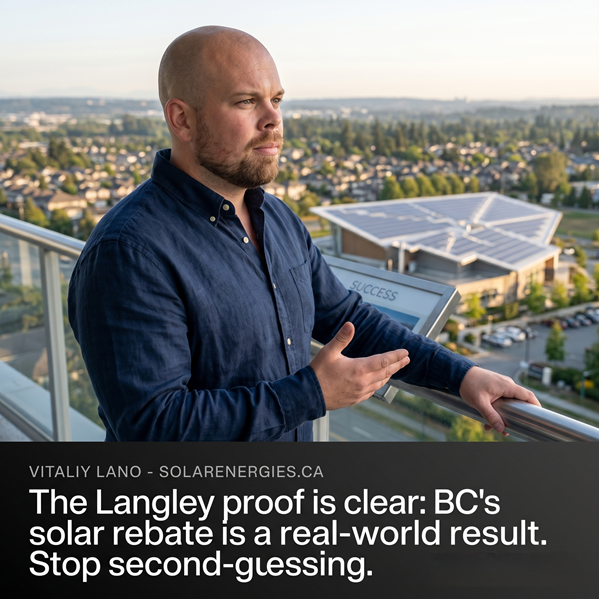
In an article released this week on the Canadian solar education site SolarEnergies.ca, Lano broke down the recent Langley Presbyterian Church solar installation — a $56,000 rooftop project completed in time for Earth Day and partially funded through BC Hydro’s self-generation rebate program. The wider electrification package at the church, which also includes heat pumps, totals roughly $170,000, with the solar portion representing the part eligible for utility support.
“The rebate is real. The money actually shows up. And the process is less mysterious than most people think,” Vitaliy stated in the article, pointing to the Langley congregation as living evidence that BC residents can stop second-guessing the program.
Lano, a solar energy enthusiast with 12 years of experience in home improvement and sustainability, has spent years reviewing Canadian solar companies and translating incentive programs for homeowners and small business owners. SolarEnergies.ca operates under the slogan “Canada Goes Solar,” and Lano’s analysis of the Langley project reflects the site’s core mission of turning utility paperwork into practical, plain-language guidance.
According to the piece, BC Hydro’s residential solar rebate pays up to $5,000 for grid-connected solar panels and up to another $5,000 for battery storage, calculated at $1,000 per installed kilowatt and capped at 50 percent of installed cost. Small businesses and commercial properties — the category the Langley church qualified under — can pull up to $10,000 for solar and $10,000 for batteries on qualifying accounts.
“Programs change. Rebates get tighter, not looser. The Langley church didn’t wait for perfect conditions — they applied under current rules, used what was available, and got work done,” Lano commented, referencing a recent conversation with a Surrey homeowner who had considered delaying her install.
The article cites reporting from the Langley Advance Times, which confirmed the $56,000 solar figure, as well as the congregation’s own online posts tracking the installation’s progress. Lano pointed out that while local coverage used the word “grant,” BC Hydro’s formal structure calls it a rebate, delivered through its self-generation stream. Both terms describe the same pathway.
Lano expressed optimism about the wider BC market, citing BC Hydro data showing more than 17,000 customers enrolled in self-generation as of February 2026. He added that the utility’s March 2026 newsletter credited the rebate program with helping grow solar installations across the province.
“This isn’t a one-off feel-good story. The program works. It’s funded. And it’s being used,” he suggested, framing the Langley story as a practical template rather than a policy outlier.
The SolarEnergies.ca article also flagged an upcoming shift homeowners should plan around. On July 1, 2026, BC Hydro transitions solar customers to Rate Schedule 2289, which pays 10 cents per kilowatt-hour for excess generation. Beginning June 1, 2026, installers must belong to the Home Performance Contractor Network for their customers’ rebate applications to be accepted.
Lano was quick to point out that these changes are not setbacks. “For anyone sizing a system to cover their own usage — which is most homeowners — it barely moves the needle,” he expressed, adding that the most common mistake he sees is homeowners waiting for a better deal that never arrives.
Timing of the rebate payout is another area where Lano pushed for clarity. Payment arrives roughly 30 to 45 business days after BC Hydro approves interconnection — never upfront. Applicants in the Township of Langley must file a building permit with structural drawings sealed by a professional engineer plus a separate electrical permit through Technical Safety BC.
“If a 12-person church committee can do it, a homeowner’s family or a small business board can do it too,” Lano suggested, encouraging community buildings, non-profits, and small business owners to look seriously at the commercial rebate tier.
Lano added that the Langley project should reassure homeowners who have been sitting on quotes for months. “The finish line exists. People keep asking if these rebates are real. Yes. They’re real — they just arrive after the work is done, through utility channels,” he commented.
###
For more information about Solar Energies In Canada SEIC, contact the company here:
Solar Energies In Canada SEIC
Vitaliy Lano
2368680609
admin@solarenergies.ca