
New Global Poll: Amid Growing Pessimism, Security Tops Priorities for International Cooperation
PR Newswire
NEW YORK, Sept. 16, 2026
- Support for international cooperation holds steady even as nearly 7 in 10 say the world has gotten worse over the past year
- After learning the projected human cost of recent aid cuts, majorities in all 34 countries favor reversing cuts or increasing aid
NEW YORK, Sept. 16, 2026 /PRNewswire/ — As world leaders prepare to gather in New York for the United Nations General Assembly, a new 34-country survey — the second annual installment of The Rockefeller Foundation’s global research on international cooperation — finds that people around the world are increasingly pessimistic about the state of the world but are not turning inward. Preventing wars and conflicts is the clearest shared priority for countries to work together on, selected by more people than any other issue, and a majority of those surveyed look to countries acting together — more than their own governments — to address it. The survey also finds majorities in every country favor reversing recent aid cuts or increasing assistance after learning their projected human cost. While neither the United States nor China command broad public support to lead globally, six international institutions playing important roles across global challenges gained trust among those surveyed since last year.
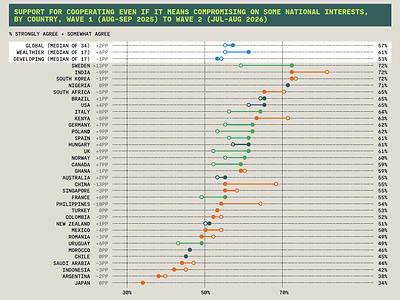
Nearly seven in ten people (69%) say the world has gotten worse over the past year, and economic optimism has fallen in 27 of the 34 countries surveyed. Yet 57% say their country should cooperate to solve global challenges even when doing so requires compromising some national interests, up slightly from 55% in 2025.
That global figure masks a limited but measurable divergence between wealthier and developing economies. In 2025, support stood at 55% in both groups. This year, it rose to 61% in wealthier economies and fell to 53% in developing economies. Across both groups, however, preventing wars and conflicts is the leading shared priority.
“The world is living through a period of extraordinary disruption, and this poll makes clear that people in 34 countries are starting to feel it, often for the worse,” said Dr. Rajiv J. Shah, President of The Rockefeller Foundation. “But they are not asking their leaders to turn inward. They want countries to work together to prevent conflict, solve problems that cross borders, and deliver results that they can see in their own lives. The challenge for leaders gathering at the United Nations is to meet this moment — and that demand — by finding ways to work together and really deliver results.”
Conducted by Focaldata between July 21 and August 5, 2026, the survey reached 35,399 adults across 34 countries, following a 2025 survey of the same countries. The research is part of The Rockefeller Foundation’s Build the Shared Future initiative, housed within its affiliated public charity, RF Catalytic Capital, Inc., which works to advance more effective models of international cooperation and development.
“The international system was built for a different era, but the need for countries to work together has never been clearer,” said Gordon Brown, former Prime Minister of the United Kingdom and trustee at The Rockefeller Foundation. “These findings show that in every country a majority of people want cooperation that keeps them safe and delivers in their lives. Leaders now have an opportunity, with clear public support, to come together around a renewed set of principles — rooted in shared values, mutual responsibility, and respect between nations — that can provide a foundation for cooperation in the world we live in today.”
Security Is the World’s Shared Priority
Preventing wars and conflicts is the most widely selected priority for countries to work together on, chosen by 44% — 11 percentage points ahead of the next-ranked issue. It ranks first in 21 of the 34 countries surveyed, in the top two in 33, and no lower than third in any country. The priority has also risen since late 2025. Among 18 countries included in a comparable November 2025 survey, preventing wars and conflicts increased in 13, with the median rising from 41% to 44%.
The public also sees collective action as central to delivering security. When asked who is most responsible for preventing wars and conflicts, groups of countries working together are the leading choice in both wealthier economies (45%) and developing economies (38%), while only around one in five names their own national government.
Majorities Support Reversing Aid Cuts After Learning Their Projected Human Cost
The survey also assessed attitudes toward recent reductions in international aid. Respondents were first told that research estimates recent aid cuts could lead to more than nine million deaths in the world’s poorest countries by 2030, mostly from preventable disease and malnutrition. They were then asked to choose among statements tailored to donor, recipient or middle-income countries.
After receiving that information, a majority in every one of the 34 countries surveyed chose either a moral or national-interest reason for reversing recent cuts or increasing aid. Support ranges from 54% in the United Kingdom to 82% in Brazil and includes 61% in the United States. Globally, about one in five says the cuts were the right decision.
The mortality estimate comes from a peer-reviewed study by the Barcelona Institute for Global Health (ISGlobal), published in The Lancet Global Health and supported by The Rockefeller Foundation.
While neither argument commands a majority on its own, respondents are more likely to support aid because they see it as serving their country’s long-term interests than because they believe their country has a moral responsibility to help people in need. Among donor countries, 37% choose the long-term-interest argument and 26% the moral argument; among recipient countries, the split is 49% to 23%, and among middle-income countries, 45% to 26%.
At the same time, the findings do not point to support for a foreign policy based on self-interest alone. When forced to choose, 56% say their country’s foreign policy should reflect its national values even if that means missing out on beneficial deals, compared with 44% who prefer getting the best deal for citizens even if it means compromising national values.
A World Less Willing to Wait for Superpowers
The poll also reveals a fragmented global leadership landscape in which neither the United States nor China commands broad public confidence. Only 39% say they are comfortable with the United States playing a leading role in world affairs, and 37% say the same of China. Several other countries receive substantially higher ratings, including Canada (60%), Japan (58%), Australia (55%), and the United Kingdom (54%).
Threat perceptions vary sharply by geography. Excluding respondents rating their own country, 42% call Russia a major threat to their country, 34% say the same of the United States and 30% of China. Russia is most salient as a threat in much of Europe, the United States is the most-cited of the three in 13 of 17 developing markets, and concern about China is concentrated in its region.
Yet uncertainty over global leadership has not translated into rejection of collective action. Sixty-one percent support a group of countries working together on global problems even if neither the United States nor China participates, compared with 12% who oppose the idea. Among the 32 countries asked, support is at least 49% in every market and at least 50% in 29.
At the same time, trust has increased since 2025 in all six international institutions tracked by the survey. The World Health Organization rose to 69% and the United Nations to 62%, while the World Bank, World Trade Organization and International Monetary Fund all crossed from minority to majority trust.
Support Holds, with a Growing Gap Between Wealthier and Developing Economies
Overall support for cooperation has held: 57% say their country should cooperate to solve global challenges even if it means compromising on some national interests, compared with 55% in 2025. But the two economic groups have moved in different directions, from 55% support in each last year to 61% in wealthier economies and 53% in developing economies today.
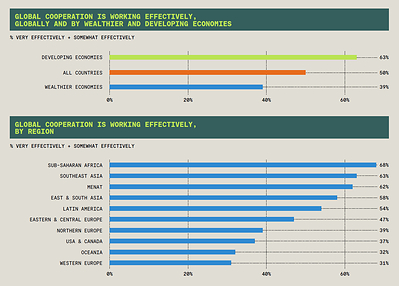
Effectiveness matters: 81% say they would support international cooperation more if it proved it could solve global problems effectively, and 80% say the same if it could solve problems in their own country.
About the Survey
Focaldata conducted nationally representative polls in 34 countries, capturing responses from 35,399 quantitative respondents. These were carried out from July 21 to August 5 2026, with broad geographic coverage.
The survey reached representative cohorts based on age, gender, region, education, ethnicity, and most recent political vote to achieve nationally representative samples in each country, with ethnicity and past political votes used only where such measures are collected and standard practice. The sample was then weighted to be representative by the same variables.
With samples ranging from 754 to 1,338, the margin error at the 95% confidence level is approximately ±2–4 percentage points, with most countries around ±3.0 percentage points.
Global, wealthier and developing figures are medians of the country percentages unless stated otherwise. Regional figures are averages of the country percentages within each region. The report groups 17 countries as wealthier economies and 17 as developing economies.
About The Rockefeller Foundation
Investing $30 billion over the last 113 years to promote the well-being of humanity, The Rockefeller Foundation is a pioneering philanthropy built on unlikely partnerships and innovative solutions that deliver measurable results for people in the United States and around the world. We leverage scientific breakthroughs, artificial intelligence, and new technologies to make big bets across energy, food, health, and finance, including in association with our affiliated public charity, RF Catalytic Capital. For more information, sign up for our newsletter at www.rockefellerfoundation.org/subscribe and follow us on X @RockefellerFdn, Instagram @rockefellerfdn, YouTube @RockefellerFdn, and LinkedIn @the-rockefeller-foundation.
 View original content to download multimedia:https://www.prnewswire.com/news-releases/new-global-poll-amid-growing-pessimism-security-tops-priorities-for-international-cooperation-302879936.html
SOURCE The Rockefeller Foundation


