248 US surgery centres opened in a year, and a 2026 Medicare rule change lets clinics do more. The studies map the opening.
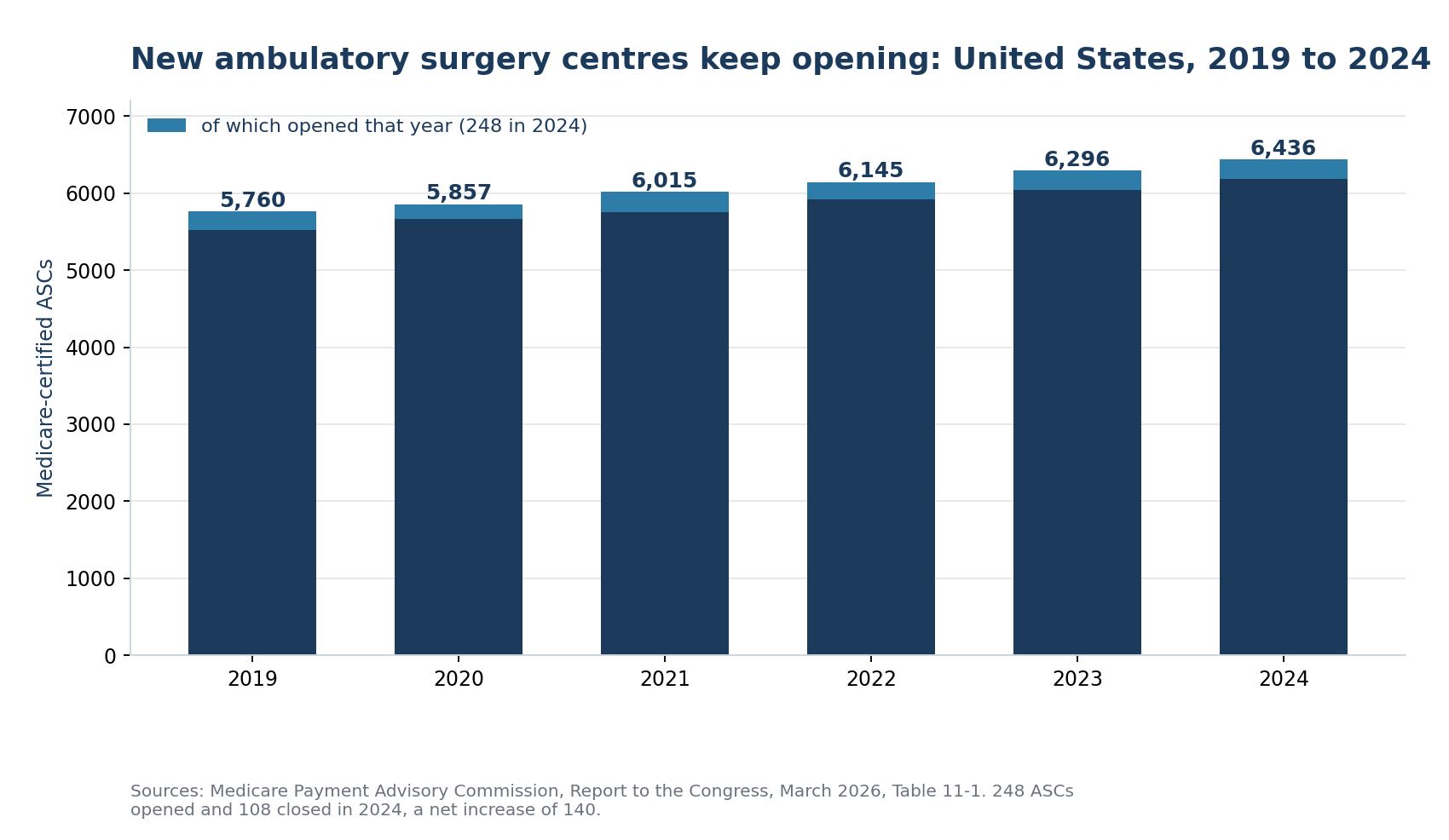
ZURICH, SWITZERLAND, July 28, 2026 /EINPresswire.com/ — For a new operator in 2026, the opening in healthcare is not a hospital. In the United States, 248 new ambulatory surgery centres opened during 2024 while 108 closed or merged, a net gain of 140 that took the number of Medicare-certified centres to 6,436, according to the Medicare Payment Advisory Commission’s March 2026 report to Congress. More than 95 percent of them are for-profit businesses.
The openings are not a one-year spike, since the count has risen every year since 2019. What changed in 2026 is how much a clinic is allowed to do. Medicare began phasing out its inpatient-only list on 1 January 2026, and in the first step of that three-year phase-out 271 procedure codes moved onto the ambulatory surgery covered list, with a further 276 procedures added under revised criteria. States including Georgia and North Carolina have rolled back certificate-of-need rules, the licensing tests that limited where a new clinic could open. All of it is recorded in the same MedPAC report.
eFinancialModels’ studies read the same shift inside hospital walls. The USA Healthcare and Hospital Market Study puts outpatient care at 57 percent of US hospital net patient revenue in 2024, rising to 64 percent by 2031 in its Base Case. In Australia, 75 percent of private hospitalisations were same-day in 2024-25 against 56 percent in public hospitals, according to the Australian Institute of Health and Welfare. Both figures measure hospitals moving their own mix toward day and outpatient work, which the studies read as the same demand that fills a standalone clinic.
Behind it sits demographics. In Germany, one person in four will be aged 67 or older by 2035, up from one in five in 2024, on every variant of the federal statistics office Destatis’ latest population projection, and long-term care is the secular demand driver in eFinancialModels’ Germany study. Each market opens a different door: ambulatory surgery in the United States, fertility and specialist clinics in the United Kingdom, and the Tier-2 and Tier-3 cities the India study calls the build-out frontier.
A day clinic or specialist centre can be scoped, costed and opened on a scale a first general hospital never could. The question is no longer whether the demand exists. It is which niche, in which market, and whether the numbers work.
“For years, healthcare looked like a market only large operators could enter,” said a spokesperson for eFinancialModels. “That has changed. The growth is now in the smaller, focused settings, and those are exactly the ones a founder can build and finance. What decides whether a clinic is worth starting is the model underneath it: fit-out cost, who pays and how fast, and how long before it returns the capital.”
That is a modelling question before it is a clinical one: what the fit-out costs, which payers fund it and how fast they settle, the volumes that carry the fixed base, and the month it turns cash positive. Each one is an assumption a founder can test before signing a lease.
The seven market studies behind this release, covering the United States, United Kingdom, Germany, Australia, Singapore, India and Brazil, are free to download, and founders can build their own numbers with the clinic and healthcare financial model templates at eFinancialModels.
Communications Team eFinancialModels
eFinancialModels
info@efinancialmodels.com
Visit us on social media:
LinkedIn
Bluesky
Instagram
Facebook
YouTube
TikTok
X
Legal Disclaimer:
EIN Presswire provides this news content “as is” without warranty of any kind. We do not accept any responsibility or liability
for the accuracy, content, images, videos, licenses, completeness, legality, or reliability of the information contained in this
article. If you have any complaints or copyright issues related to this article, kindly contact the author above.

Media gallery