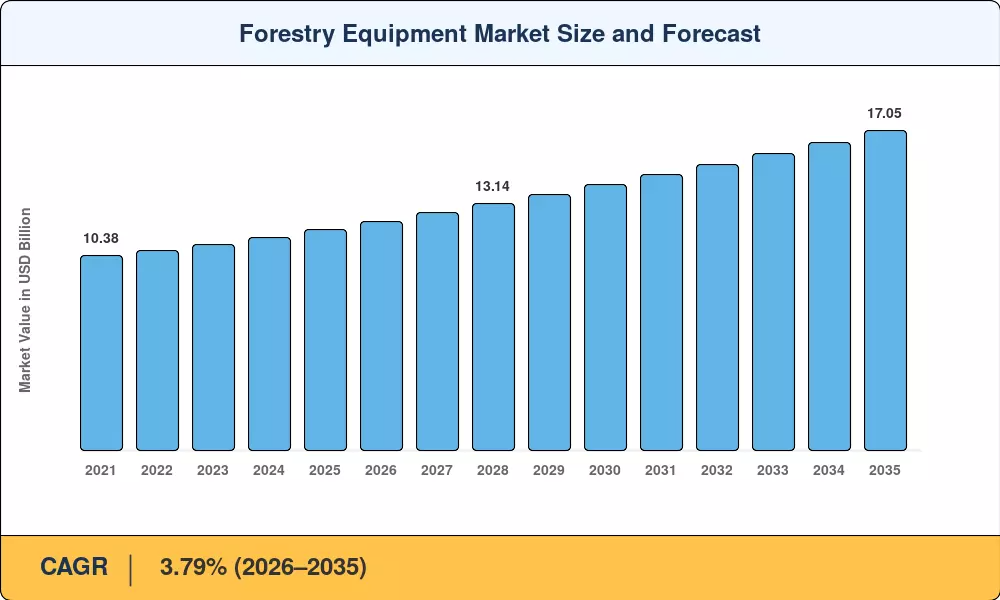
The Forestry Equipment Market was valued at USD 11.75 Billion in 2025 and is projected to grow from USD 12.20 Billion in 2026 to USD 17.05 Billion by 2035.
NEW YORK, NY, UNITED STATES, July 28, 2026 /EINPresswire.com/ — Forestry equipment encompasses a broad range of specialized machinery and tools designed for forestry operations, including the cultivation, management, and harvesting of trees and forests . This includes machinery such as harvesters, skidders, forwarders, feller-bunchers, and chippers, all engineered to improve efficiency and sustainability in forest operations . The sector serves diverse applications ranging from commercial logging and land clearing to forest fire management and biomass harvesting.
The market is experiencing steady growth driven by several converging factors. Increasing global demand for timber and wood products, fueled by construction industry expansion and urbanization, is a primary growth driver . Rapid urban development escalates the need for sustainable wood products, necessitating advanced machinery that enhances productivity while minimizing environmental impact . Additionally, the growing bioenergy sector, which relies on wood and biomass for renewable energy production, has significantly contributed to market expansion .
Industry trends indicate a decisive shift toward sustainable forestry practices and the adoption of advanced technologies. There is increasing demand for low-emission, fuel-efficient machinery as environmental concerns and stricter regulations on deforestation and biodiversity protection prompt investments in eco-friendly operations . Manufacturers are developing equipment that supports responsible harvesting, forest regeneration, and minimal environmental disturbance, aligning with global sustainability objectives.
Technological developments are reshaping the forestry equipment landscape. Integration of automation, GPS technology, and remote-controlled machinery is enhancing operational productivity and precision . Innovations such as automated and remote-controlled felling machines are gaining traction, offering improved fuel efficiency, reduced emissions, and enhanced cutting precision . The incorporation of telematics and data analytics enables predictive maintenance and optimized fleet management, reducing downtime and operational costs.
Policy and regulatory influence on the market is substantial. Government policies supporting forest conservation, sustainable land management, and responsible harvesting practices stimulate market growth . Stricter emissions regulations are accelerating the shift toward cleaner power sources, including electric and hybrid systems in forestry equipment . Additionally, policies promoting bioenergy and renewable resources create new opportunities for forestry equipment applications in biomass harvesting and wood processing.
The demand outlook remains positive, supported by replacement of older, less productive equipment and the increasing adoption of mechanized solutions in forestry operations . The growing focus on automation and technology integration is further accelerating market growth as companies seek to optimize productivity and enhance decision-making capabilities. Emerging markets, particularly in Asia-Pacific and South America, present significant growth opportunities driven by expanding forestry activities and infrastructure development.
📍 Get Free Sample Report for Detailed Market Insights:
https://www.marketresearchfuture.com/sample_request/26097
Market Segmentation
By Product Type
The forestry equipment market is segmented by product type into Felling Equipment, Extracting Equipment, and Other Forestry Equipment . Felling equipment, including feller-bunchers and chainsaws, is used for severing trees from stumps, a critical first step in the harvesting process . This segment holds a significant market share driven by increasing timber demand in construction and paper industries, coupled with technological advancements that improve fuel efficiency and reduce emissions . Modern felling equipment is designed to minimize environmental impact through features like reduced soil disturbance and controlled tree removal . Extracting equipment, which includes skidders and forwarders, is essential for transporting felled trees from the cutting site to loading areas . Skidders drag processed trees to collection points, while forwarders carry logs without dragging, reducing soil damage. Other forestry equipment encompasses on-site processing machinery, dozers for road building and site preparation, graders for maintaining forest service roads, and excavators for land clearing and stump removal .
By Power Source
Power source segmentation divides the market into Diesel-Powered, Petrol/Oil-Powered, and Electric-Powered equipment . Diesel-powered equipment currently dominates the market due to its reliability, longevity, and suitability for rugged, remote environments where high performance and extended operational hours between refueling are crucial . These machines offer the power and durability required for heavy-duty logging operations and large-scale forestry tasks. Petrol/Oil-powered equipment continues to serve various applications, particularly in smaller-scale operations and for portable tools like chainsaws. Electric-powered equipment represents an emerging and rapidly growing segment driven by environmental regulations and the push toward sustainable practices . The integration of electric and hybrid systems is expected to increase as industries move toward more eco-friendly solutions, offering reduced emissions and lower operational noise . Advancements in battery technology and charging infrastructure are supporting the adoption of electric machinery, particularly in environmentally sensitive areas and urban forestry applications.
By Application
Application-based segmentation covers Logging, Land Clearing, Forest Fire Management, and Biomass Harvesting. Logging remains the largest application segment, driven by global timber demand for construction, paper production, and furniture manufacturing. Increasing mechanization in logging operations improves productivity and worker safety while reducing costs. Land clearing applications involve preparing land for agriculture, infrastructure development, and reforestation projects, driving demand for dozers, excavators, and specialized clearing equipment. Forest fire management is a critical and growing application, with equipment used to create firebreaks, clear vegetation, and support firefighting operations . Dozers are frequently deployed during forest fires to create fire breaks that disrupt the path of fires and prevent further spread . Biomass harvesting, fueled by the growing bioenergy sector, involves collecting wood residues and dedicated energy crops for power generation and pellet production, creating new opportunities for specialized harvesting and processing equipment.
By End-User
End-user segmentation includes Commercial Logging Companies, Government Forestry Agencies, and Rental Service Providers. Commercial logging companies represent the largest end-user segment, investing in advanced machinery to improve operational efficiency and remain competitive in timber markets. These companies are increasingly adopting mechanized solutions to address labor shortages and enhance productivity. Government forestry agencies manage public forests and parks, utilizing equipment for sustainable forest management, conservation, and fire prevention activities. Government policies supporting sustainable forestry practices and conservation initiatives drive demand in this segment. Rental service providers are gaining importance as forestry operators seek flexible access to specialized equipment without the significant capital investment required for purchase. The rental model is particularly attractive for seasonal operations, project-based work, and equipment trials, supporting market growth through increased equipment accessibility.
By Region
Regional segmentation includes North America, Europe, South America, Asia Pacific, and the Middle East and Africa. North America leads the global forestry equipment market, driven by a combination of sustainable forestry practices, technological innovation, and a strong supply chain . The United States and Canada are key markets, with government policies supporting forest conservation and sustainable land management stimulating market growth. Rising demand for timber driven by the construction industry, along with forest conservation initiatives, further propel regional dominance . Europe represents a mature market characterized by stringent environmental regulations and advanced forestry practices, with Germany, the UK, and France being major contributors. Asia Pacific is the fastest-growing regional market, fueled by rapid urbanization, increasing timber consumption, and expanding forestry activities in China, India, and Southeast Asian countries. South America, particularly Brazil, presents significant growth opportunities driven by extensive forest resources and increasing investments in mechanized forestry operations. The Middle East and Africa region is emerging, with growing forestry and land management activities supporting gradual market development.
🛒 You can buy this market report at:
https://www.marketresearchfuture.com/checkout?currency=one_user-USD&report_id=26097
Regional Analysis
North America
North America commands a dominant position in the global forestry equipment market . The United States is the largest national market, benefiting from extensive forest resources, a strong logging industry, and the presence of major equipment manufacturers . Canada contributes significantly to the regional market with its vast forest lands and established forestry sector. The region’s focus on sustainable forestry practices has increased demand for advanced machinery that improves efficiency while minimizing environmental impact . Technological innovations, including automation, GPS integration, and telematics, have further boosted operational productivity . Government policies supporting forest conservation and sustainable land management stimulate market growth, while forest conservation and restoration initiatives create additional demand for specialized equipment . The replacement of older, less productive equipment and increasing mechanization in logging operations continue to support North American market growth .
Europe
Europe represents a sophisticated market characterized by stringent environmental regulations, sustainable forestry practices, and a strong emphasis on technological innovation. Germany, France, the UK, and Italy are major national markets with well-established forestry sectors. European regulations on deforestation and biodiversity protection encourage investments in low-emission, fuel-efficient machinery . The region is at the forefront of adopting electric and hybrid forestry equipment, driven by emissions reduction targets and sustainability commitments. The growing demand for sustainable forestry practices and renewable materials further boosts the need for innovative harvesting technologies . Central and Eastern European countries are emerging as growing markets, benefiting from expanding forestry activities and increasing mechanization.
Asia-Pacific
Asia-Pacific is the fastest-growing regional market for forestry equipment, driven by rapid urbanization, rising timber consumption, and infrastructure development across the region. China leads regional growth with its extensive forest resources and increasing investments in mechanized forestry operations. India, Southeast Asian countries, and Japan are key markets, each presenting unique growth drivers. Rising demand for sustainable wood products and efficient forest management practices is escalating the need for modern forestry equipment as urban areas expand . The region’s increasing focus on renewable energy sources, particularly wood pellets for bioenergy, creates additional opportunities for forestry equipment applications . Growing mechanization in logging and forest management activities, along with government policies supporting sustainable land use, positions Asia-Pacific for continued market expansion.
Rest of the World
The Rest of the World segment, encompassing South America and the Middle East and Africa, presents developing market opportunities. South America, particularly Brazil, is a significant market due to its extensive Amazon rainforest and established logging industry. Increasing investments in mechanized forestry operations, driven by productivity and sustainability requirements, support market growth in the region. The Middle East and Africa region is gradually emerging, with forestry and land management activities supporting initial market development. Growing awareness of sustainable forestry practices and infrastructure development across these regions create potential for future market expansion.
Competitive Landscape / Key Players
The global forestry equipment market is characterized as fragmented, with a mix of established industry leaders and emerging players competing on technology, product quality, and service capabilities . Key companies operating in this market include:
Deere & Company
Hitachi Construction Machinery Co. Ltd.
Volvo Group (Volvo Construction Equipment)
Komatsu Limited
Ponsse PLC
Caterpillar Inc.
Husqvarna Group
CNH Industrial N.V.
Bell Equipment Limited
Tigercat International Inc.
Barko Hydraulics, LLC
Rottne Industri AB
Strategic developments in the market include investments in research and development for advanced technologies such as automation, remote-controlled operations, and alternative power sources. Manufacturers are focusing on developing equipment that enhances efficiency while supporting sustainability, positioning themselves for competitive advantage as environmental regulations intensify . The integration of GPS, telematics, and data analytics into forestry equipment is increasingly differentiating market players. Partnerships between equipment manufacturers and forestry companies are becoming more common, enabling collaborative development of specialized solutions.
Market positioning varies among competitors, with some companies focusing on high-performance, premium-priced equipment for large-scale logging operations. Others concentrate on cost-effective solutions for smaller operators and emerging markets. Several players have established strong positions in specialized segments such as electric and hybrid equipment, responding to growing demand for eco-friendly solutions. The presence of regional manufacturers in various markets further diversifies the competitive landscape.
Latest Industry News & Developments
Recent industry developments highlight the ongoing transformation of forestry equipment toward greater sustainability and automation. The shift toward electric and hybrid systems is gaining momentum, with manufacturers investing in alternative power sources to meet emissions standards and environmental regulations . Development of advanced automation technologies, including autonomous forestry machines and remote-controlled operations, continues to advance, aiming to improve worker safety and operational efficiency .
Industry focus on sustainable forest management practices has intensified, driving demand for equipment designed to minimize soil disturbance, protect biodiversity, and support forest regeneration . Manufacturers are incorporating features such as precision harvesting capabilities and reduced ground pressure to meet these requirements. The growing bioenergy sector is creating new opportunities for specialized equipment in biomass harvesting and wood processing, prompting companies to develop products tailored to these applications .
Market Challenges & Opportunities
Key restraints facing the forestry equipment market include high capital costs associated with purchasing specialized machinery, which can be prohibitive for smaller operators and companies in emerging markets. The high maintenance costs of forestry equipment, operating in demanding conditions, present ongoing challenges for operators . Competition from emerging market manufacturers offering lower-cost alternatives can impact established players’ market share . The complexity of complying with varying environmental and safety regulations across different regions adds operational challenges and costs.
Emerging opportunities in the market are substantial and diverse. The accelerating transition toward sustainable forestry practices presents significant opportunities for equipment designed to support responsible harvesting, reduce environmental impact, and improve operational efficiency . Growing demand for eco-friendly machinery, including electric and hybrid equipment, creates new product development opportunities . The expanding bioenergy sector requires specialized equipment for biomass harvesting, processing, and transportation, representing a growing market segment .
To explore more market insights, visit us at:
https://www.marketresearchfuture.com/reports/forestry-equipment-market-26097
Final Market Summary
The forestry equipment market is positioned for steady growth through 2035, driven by increasing global demand for timber and wood products, expanding construction and bioenergy sectors, and growing adoption of sustainable forestry practices. The projected valuation of USD 17.05 billion reflects sustained demand across commercial logging, land clearing, forest fire management, and biomass harvesting applications.
The medium-term growth outlook remains positive, supported by replacement of aging equipment, technological innovations in automation and power sources, and increasing environmental regulations driving adoption of eco-friendly machinery. North America will continue to maintain its market leadership through technological advancement and strong supply chains, while Asia-Pacific emerges as the fastest-growing regional market driven by rapid urbanization and infrastructure development .
Long-term industry potential extends beyond the current forecast horizon. The convergence of sustainability imperatives, technological advancement, and renewable energy demand will continue to reshape the market landscape. Manufacturers that successfully develop low-emission, automated, and efficient equipment for next-generation forestry applications will capture value in this evolving market. Those that embrace innovation, expand digital offerings, and address sustainability requirements will be best positioned for success in the forestry equipment market of the future.
More Related Reports from MRFR Library:
Heating Ventilation Air Conditioning Market: https://www.marketresearchfuture.com/reports/heating-ventilation-air-conditioning-market-801
High Pressure Pumps Market: https://www.marketresearchfuture.com/reports/high-pressure-pumps-market-1880
Air Separation Plant Market: https://www.marketresearchfuture.com/reports/air-separation-plant-market-1997
Water Purifier Market: https://www.marketresearchfuture.com/reports/water-purifier-market-2178
Agriculture Equipment Market: https://www.marketresearchfuture.com/reports/agriculture-equipment-market-2182
Bearing Market: https://www.marketresearchfuture.com/reports/bearing-market-2183
India Rice Milling Market: https://www.marketresearchfuture.com/reports/india-rice-milling-market-3566
Power Tools Market: https://www.marketresearchfuture.com/reports/power-tools-market-3571
Personal Protective Equipment Market: https://www.marketresearchfuture.com/reports/personal-protective-equipment-market-3826
Water Wastewater Treatment Equipment Market: https://www.marketresearchfuture.com/reports/water-wastewater-treatment-equipment-market-3960
Larry Wilson
WantStats Research And Media Pvt. Ltd.
+1 855-661-4441
email us here
Legal Disclaimer:
EIN Presswire provides this news content “as is” without warranty of any kind. We do not accept any responsibility or liability
for the accuracy, content, images, videos, licenses, completeness, legality, or reliability of the information contained in this
article. If you have any complaints or copyright issues related to this article, kindly contact the author above.

Media gallery