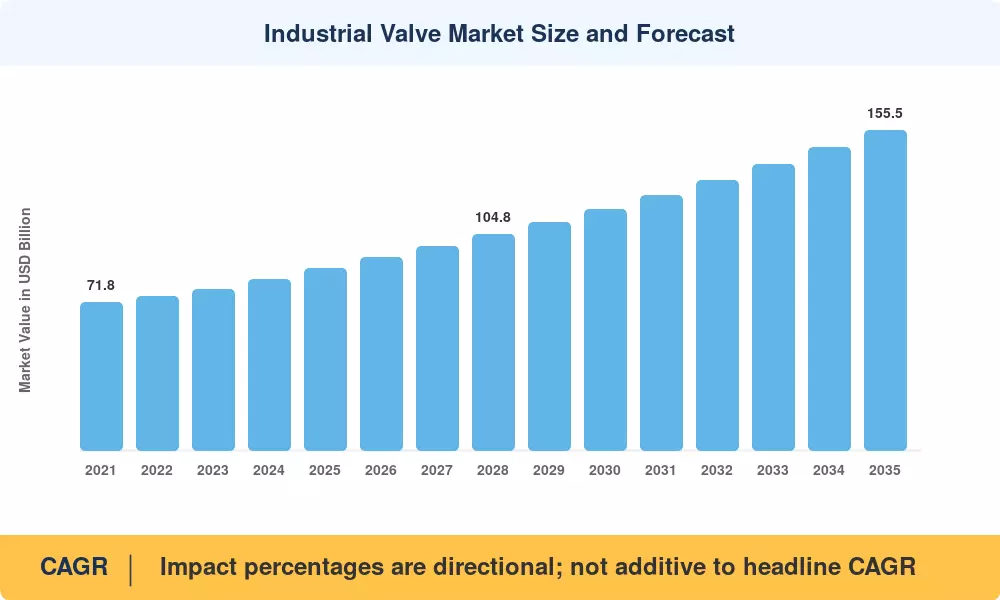
The Industrial Valve Market reached an estimated USD 88.5 billion in 2025, positioning it to grow from USD 93.6 billion in 2026
NEW YORK, NY, UNITED STATES, July 27, 2026 /EINPresswire.com/ — The Industrial Valve Market reached an estimated USD 88.5 billion in 2025, positioning it to grow from USD 93.6 billion in 2026 to USD 155.5 billion by 2035 at a compound annual growth rate of 5.8% during the 2026–2035 forecast window.
Market Overview
Industrial valves are critical flow-control devices used to regulate, direct, and control the flow of liquids, gases, slurries, and other materials across a vast array of industrial processes. These electromechanical components are fundamental to maintaining operational efficiency and safety in pipelines and processing plants. Industrial valves are primarily manufactured using materials such as stainless steel, carbon steel, cast iron, and high-performance alloys to withstand demanding conditions including high pressure, extreme temperatures, and corrosive media .
The global industrial valve market is experiencing steady growth driven by several powerful catalysts. A global wave of aging infrastructure replacement is a primary driver—the American Society of Civil Engineers estimates USD 2.6 trillion in deferred water infrastructure investment in the U.S. alone . Simultaneously, tightening fugitive emissions regulations across oil-producing nations mandate upgraded sealing technologies in pipeline networks . The oil and gas sector, which represents the single largest demand vertical contributing roughly 28% of global spend, is projected to invest approximately USD 1.5 trillion in upstream, midstream, and downstream activities, further fueling demand .
Industry trends indicate a decisive shift toward digitalization and automation. Legacy manual actuators and analog positioners are being replaced by smart valve assemblies equipped with embedded sensors, digital twins, and IIoT connectivity . The International Energy Agency projects that digitized process plants could reduce unplanned downtime by 20–30% by 2030, driving upstream and midstream operators to accelerate valve automation investments . The market is increasingly defined by reliability, lifecycle cost, emissions performance, and compliance with standards such as API, ASME, ISO, IEC 61508, and IEC 61511 .
Technological developments are reshaping the valve landscape. Artificial intelligence is emerging as a cumulative force across valve design, selection, manufacturing, and maintenance. AI models use vibration, acoustic, pressure, temperature, flow, and actuator signature data to detect cavitation, stiction, seat wear, packing leakage, and actuator degradation before failure, supporting predictive maintenance and reducing unplanned shutdowns . The integration of sensors, actuators, and real-time monitoring features is enhancing efficiency through predictive maintenance .
Policy and regulatory influence on the market is substantial. Governments in the EU and India have introduced stricter methane abatement mandates that directly increase demand for low-emission valve designs . The EU’s revised Industrial Emissions Directive tightens fugitive-emission thresholds for refineries and chemical plants, compelling operators to retrofit or replace existing isolation and control valves with certified low-leak alternatives . The European Union’s Machinery Directive (2006/42/EC) mandates that all industrial valves and actuators meet specific safety and performance standards, including CE marking, technical documentation, and conformity assessment procedures .
The demand outlook remains strongly positive, supported by industrial expansion, infrastructure development, and the need for efficient process control and safety. The expansion of water and wastewater treatment facilities, with the global market anticipated to reach USD 500 billion, is driving demand for valves tailored for effluent treatment, desalination, and purification processes . The transition to renewable energy sources including wind, solar, and geothermal power is also boosting demand for valves in energy generation systems . Asia-Pacific commands the largest share of the market at roughly 38% of 2025 revenue, buoyed by China’s petrochemical expansion and India’s Jal Jeevan Mission water infrastructure program .
📍 Get Free Sample Report for Detailed Market Insights:
https://www.marketresearchfuture.com/sample_request/7536
Market Segmentation
By Valve Type
The industrial valve market is segmented by type into Gate Valves, Ball Valves, Butterfly Valves, Globe Valves, Check Valves, Diaphragm Valves, and Others (Plug, Pinch, Needle) . Gate valves hold the largest revenue share at approximately 28% of the market, underpinned by ubiquitous use in isolation duty across oil, gas, and water networks . Ball valves register the fastest segment CAGR at 6.4% through 2035, reflecting growing LNG and hydrogen applications that demand tight shut-off and quarter-turn actuation . Butterfly valves account for an estimated USD 15.9 billion in 2025 revenue, gaining traction in large-diameter HVAC and water treatment installations . Globe valves represent approximately 12% of the market, primarily used in throttling service in power and chemical plants . Check valves, serving pump discharge protection and non-return service, are growing at a CAGR of 5.5% .
By End-User Industry
End-user segmentation covers Oil & Gas, Water & Wastewater, Power Generation, Chemical & Petrochemical, Food & Beverage, Pharmaceutical & Biotech, and Others (Mining, Pulp & Paper, HVAC) . Oil and gas remain the anchor vertical, contributing roughly 28% of global spend, driven by the sector’s extensive and continuous requirement for reliable flow-control solutions across upstream, midstream, and downstream operations . Water and wastewater utilities show a projected CAGR of 6.8%, the highest among end-user verticals, as governments prioritize clean-water access . Power generation accounts for approximately USD 13.3 billion in 2025, with combined-cycle gas turbine plants and nuclear restarts sustaining replacement demand . The chemical and petrochemical sector contributes approximately 14% of market share .
By Actuation Mode
Actuation mode segmentation includes Manual, Pneumatic, Electric, and Hydraulic actuation . Manual valves dominate by unit count at approximately 42% of share, driven by cost-sensitive isolation applications . Pneumatic actuation represents approximately USD 21.7 billion in 2025 revenue, benefiting from the existing installed base in process plants . Electric actuation is the fastest-growing segment with a CAGR of 7.8%, driven by digital integration and energy efficiency requirements . Plant operators are increasingly specifying electric actuators for new installations because they eliminate the cost and maintenance burden of compressed-air systems while offering direct integration with digital control platforms and remote-operations architectures . Hydraulic actuation accounts for approximately 8% of the market, primarily serving high-force subsea and wellhead applications .
By Region
Regional segmentation includes North America, Europe, Asia Pacific, South America, and the Middle East and Africa . Asia-Pacific leads the total market value at USD 33.6 billion in 2025, holding approximately 38% share, buoyed by China’s petrochemical expansion and India’s infrastructure programs . North America captures 25% share, anchored by U.S. LNG infrastructure and Canadian oil-sands debottlenecking . Europe follows at 22% share, anchored by hydrogen pipeline pilot projects and decarbonization retrofits . The Middle East and Africa region posts a CAGR of 6.5%, driven by Saudi Vision 2030 megaprojects and UAE gas field expansions . South America represents a smaller but growing market valued at USD 5.3 billion in 2025, driven by pre-salt offshore activities and mining .
🛒 You can buy this market report at:
https://www.marketresearchfuture.com/checkout?currency=one_user-USD&report_id=7536
Regional Analysis
North America
North America holds the second-largest share at 25%, driven by LNG export terminal buildouts, shale midstream investment, and water utility upgrades . The United States remains the single largest national market, with Gulf Coast LNG export terminals alone accounting for an estimated USD 1.8 billion in valve procurement between 2024 and 2028 . Domestic water-utility spending is accelerating as the EPA’s Lead and Copper Rule Improvements drive widespread distribution-system valve replacements . Canada contributes significantly with oil-sands debottlenecking and the Trans Mountain pipeline expansion supporting demand . The region’s strong valve specification culture and stringent OSHA regulations drive adoption of high-performance and automated valve solutions .
Europe
Europe represents a sophisticated market at 22% share, anchored by hydrogen pipeline pilot projects and decarbonization retrofits . Germany leads regional demand at 24% of European share, driven by hydrogen backbone development and the chemical industry . The European Hydrogen Backbone initiative envisions 28,000 km of dedicated hydrogen pipelines by 2030, creating new demand for valves tested and certified for hydrogen embrittlement resistance . The United Kingdom is growing at a CAGR of 5.9%, supported by North Sea decommissioning and offshore wind activities . France represents a significant market at USD 2.8 billion in 2025, driven by its nuclear fleet life-extension program . The EU Methane Regulation compels upstream operators to replace aging valve stock with certified low-emission designs .
Asia-Pacific
Asia-Pacific commands the largest share at approximately 38% of 2025 revenue and posts the fastest forecast CAGR at approximately 7.2% . China dominates regional share at 48%, driven by its USD 120 billion petrochemical capacity expansion along its eastern seaboard . India is the fastest-growing major market with a CAGR of 8.1%, fueled by the Jal Jeevan Mission water infrastructure program allocating INR 3.6 trillion (approximately USD 43 billion) to deliver piped water to every rural household by 2028 . India’s city gas distribution network is expanding to 300+ cities, each requiring extensive pressure-regulation and safety shut-off valve systems . Japan and South Korea contribute significantly through nuclear restarts, LNG import terminals, and semiconductor fabrication facility requirements . Southeast Asian countries are growing at a CAGR of 7.5%, driven by urbanization and gas-fired power buildout .
Rest of the World
The Rest of the World segment, encompassing South America, the Middle East, and Africa, presents developing market opportunities. The Middle East and Africa region posts a CAGR of 6.5%, driven by Saudi Vision 2030 megaprojects and UAE gas field expansions . Saudi Aramco’s Jafurah unconventional gas development is expected to require over 500,000 individual valve units . Desalination capacity across the GCC is set to double by 2035, sustaining demand for corrosion-resistant alloy valves in seawater service . South America is valued at USD 5.3 billion in 2025, with Brazil accounting for 62% of regional share driven by Petrobras pre-salt FPSOs . Argentina’s Vaca Muerta shale development has attracted over USD 5 billion in upstream investment commitments through 2027 .
Competitive Landscape / Key Players
The industrial valve market is moderately fragmented, with the top five players holding a combined 22–26% revenue share . Hundreds of regional manufacturers compete in commodity segments, while a smaller group of global OEMs dominates safety-critical, high-specification niches such as cryogenic, subsea, and severe-service control valves . Key companies operating in this market include Emerson Electric Co. (Fisher, Vanessa), Flowserve Corporation, IMI plc, Schlumberger (Cameron), Crane Co., KITZ Corporation, Velan Inc., Bray International, and AVK Group .
Strategic developments in the market include significant acquisitions and product innovations. In February 2026, Flowserve announced the acquisition of Trillium Flow Technologies’ Valves Division to strengthen its position in nuclear and other power end markets and expand its critical flow-control capabilities . Emerson Electric Co. holds a strong position due to its broad automation portfolio, global presence, and strong integration of valves with automation and digital monitoring technologies. Its Fisher brand strengthens its valve portfolio through control valves, actuators, regulators, and instrumentation solutions that support plant availability and safety .
Competitive differentiation increasingly rests on digital capabilities, aftermarket service networks, and certification breadth . US-based giants like Emerson and Flowserve emphasize advanced manufacturing technologies and strategic acquisitions to broaden their product portfolios .
Latest Industry News & Developments
Recent industry developments highlight the ongoing transformation of the industrial valve market toward digitalization and sustainability. In March 2024, IMI Critical Engineering completed hydrogen-compatibility testing of its full severe-service valve portfolio at pressures up to 700 bar, becoming one of the first major OEMs to certify a product line for 100% hydrogen pipeline service . This development is significant as cumulative global investment in hydrogen production and transport infrastructure is projected to exceed USD 500 billion by 2035 .
In August 2024, the European Commission published the final text of the EU Methane Regulation requiring oil, gas, and coal operators to implement mandatory leak detection and repair programs, directly driving valve replacement cycles across European upstream assets . This regulatory push is accelerating the replacement of legacy rising-stem valves with low-emission packing designs across the region.
The German industrial valves sector started 2025 with significant growth, with sales increasing by 8% in the first half of the year (4% adjusted for price changes). Domestic business rose by 6%, while foreign business grew by as much as 9%. However, exports to China fell significantly by 7.7%, while business with the USA grew by 2.3%, reflecting shifting trade dynamics and increasing competition from Chinese manufacturers in traditional export markets .
Market Challenges & Opportunities
Key restraints facing the industrial valve market include raw-material price volatility, which impacts manufacturer margins. Stainless-steel and nickel-alloy prices surged over 40% between 2021 and 2023 before partially correcting, and duplex and super-duplex steels remain subject to supply concentration risk . Extended project lead times and permitting delays—major pipeline and LNG projects in the United States and Europe now face average permitting timelines of 3–5 years—create forecast uncertainty . Competition from low-cost manufacturers, particularly from China and India offering products at 30–50% discounts, compresses margins for established players . Geopolitical uncertainties, trade restrictions, and currency fluctuations further complicate planning .
Emerging opportunities in the market are substantial and diverse. Smart valve and predictive maintenance platforms present significant potential—predictive maintenance may save process industries an estimated USD 630 billion a year in unnecessary downtime expenses by 2030 . OEMs offering outcome-based maintenance contracts can generate recurring revenue streams by integrating wireless sensor networks and AI-based analytics into valve positioners and actuators . Hydrogen-ready and CCUS valve certification represents a critical opportunity—manufacturers investing in testing, qualification, and materials R&D for 100% hydrogen service and dense-phase CO₂ transport can secure premium prices and multi-year supply contracts .
To explore more market insights, visit us at:
https://www.marketresearchfuture.com/reports/industrial-valve-market-7536
Final Market Summary
The industrial valve market is positioned for steady growth through 2035, driven by aging infrastructure replacement, tightening emissions regulations, and the accelerating adoption of smart and automated technologies. The projected valuation of USD 155.5 billion reflects sustained demand across oil and gas, water and wastewater, power generation, and chemical processing sectors, with the market transitioning from traditional manual valves toward intelligent, connected, and data-driven solutions.
The medium-term growth outlook remains positive, supported by LNG and hydrogen pipeline buildouts, water infrastructure investment programs in emerging economies, and the continued digitalization of industrial processes. Asia-Pacific will continue to lead market expansion through China’s petrochemical capacity expansion and India’s infrastructure programs, while North America and Europe maintain significant positions through technology leadership and regulatory-driven replacement cycles.
Long-term industry potential extends beyond the current forecast horizon, as the convergence of energy transition imperatives, digital transformation, and sustainability requirements reshapes the market landscape. The hydrogen and CCUS supercycle, with cumulative global investment projected to exceed USD 500 billion by 2035, introduces entirely new material and testing requirements . The electrification of actuation, with electric actuator penetration expected to exceed 40% by 2032, will continue to transform valve procurement strategies . Manufacturers that successfully combine digital capability with regional compliance expertise, invest in hydrogen-ready certification, and develop predictive maintenance platforms will capture substantial value in this evolving market.
More Related Reports from MRFR Library:
Fuel Dispenser Market: https://www.marketresearchfuture.com/reports/fuel-dispenser-market-7018
Desktop Cnc Machines Market: https://www.marketresearchfuture.com/reports/desktop-cnc-machines-market-7603
Gas Detection Equipment Market: https://www.marketresearchfuture.com/reports/gas-detection-equipment-market-7720
Drive Shaft Market: https://www.marketresearchfuture.com/reports/drive-shaft-market-7746
Off Road Equipment Market: https://www.marketresearchfuture.com/reports/off-road-equipment-market-7767
Commercial Hvac Market: https://www.marketresearchfuture.com/reports/commercial-hvac-market-7969
Tool Holder Market: https://www.marketresearchfuture.com/reports/tool-holder-market-7974
Storage Tank Market: https://www.marketresearchfuture.com/reports/storage-tank-market-8140
Tire Curing Press Market: https://www.marketresearchfuture.com/reports/tire-curing-press-market-8144
Air Purifier Market:: https://www.marketresearchfuture.com/reports/air-purifier-market-8148
Larry Wilson
WantStats Research And Media Pvt. Ltd.
+1 855-661-4441
email us here
Legal Disclaimer:
EIN Presswire provides this news content “as is” without warranty of any kind. We do not accept any responsibility or liability
for the accuracy, content, images, videos, licenses, completeness, legality, or reliability of the information contained in this
article. If you have any complaints or copyright issues related to this article, kindly contact the author above.

Media gallery