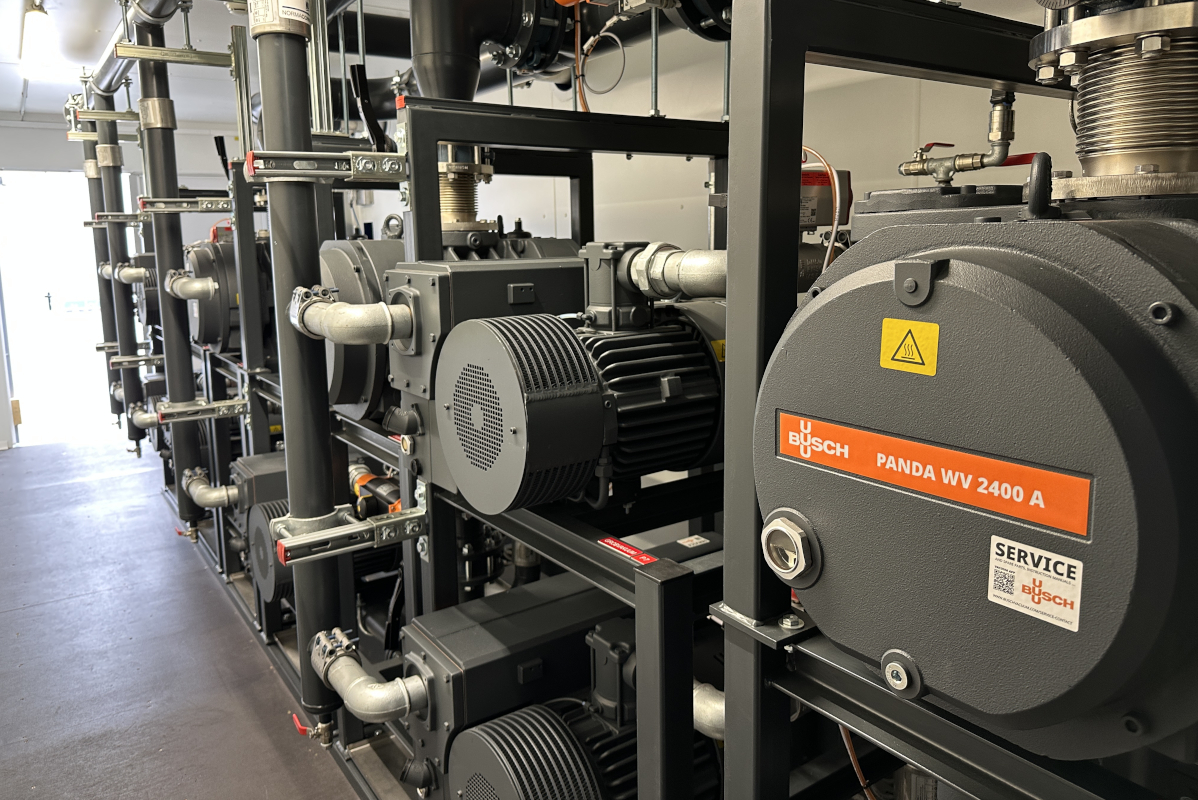
At the Migros production site in Lucerne, Switzerland, meat products are processed and packaged for the Swiss food trade.
LUCERNE, SWITZERLAND, July 27, 2026 /EINPresswire.com/ — When packing meat at Migros Luzern, a precisely timed process takes place within seconds. Vacuum is a key process parameter here and directly affects product quality, shelf life, and cycle time. Different packaging processes place varying demands on the vacuum level and require a stable and precisely controllable supply.
At the Migros production site in Lucerne, Switzerland, meat products are processed and packaged for the Swiss food trade. A total of six packaging machines cover a wide range of products.
In thermoforming packaging, for example for meat products, the packaging is first evacuated, then filled with gas and then sealed with a perimeter seal at pressures between 20 and 200 mbar. In addition, a system known as Darfresh is used, in which the product is inserted into a vacuum-formed tray and evacuated with a top film at pressures between 5 and 15 mbar.
Decentralized vacuum supply as the starting point
Prior to the update, the vacuum supply for the packaging machines was organized decentrally. A total of 18 vacuum pumps, including oil-lubricated rotary vane and vacuum boosters, supplied the six plants. The vacuum pumps were partly integrated directly into the machines and partly installed externally. Some were in a simple, uninsulated sheet metal construction on the roof. In this configuration, each packaging machine had its own vacuum pumps, which covered their entire needs across the different required pressure levels.
This structure led to several operational and economic disadvantages. The vacuum pumps integrated in the machines caused a high noise level in the production area and generated considerable waste heat. The production room had to maintain a constant temperature of around 12°C but the vacuum pumps reached ambient temperatures of 40 to 60°C, which increased the need for cooling and thus energy consumption.
There was also a lack of redundancy; if a single vacuum pump failed, the associated packaging machine stopped immediately. Any breakdown thus directly resulted in production interruptions and potential additional costs. In addition, the restricted installation position of the vacuum pumps made maintenance work more difficult. Enlargements were also inefficient, as new machines required additional vacuum pumps, associated with corresponding investment and operating costs.
The solution: central vacuum system in a container
Due to these disadvantages, Migros Luzern and Busch Vacuum Solutions decided to fundamentally reorganize the vacuum supply. The aim was to completely outsource vacuum technology from the manufacturing area in order to free up manufacturing space and be able to perform maintenance work outside the manufacturing area.
Some of the vacuum pumps had already been installed on the roof, but without a comprehensive system concept. With the acquisition of two additional packaging machines and the resulting further increase in space requirements in the manufacturing area, a fundamental reorganization of the vacuum supply was required.
Instead of continuing to equip each packaging machine separately with its own vacuum pumps, a central vacuum supply was implemented. With this concept, a common vacuum system generates the required vacuum and makes it available to all connected machines via a network of pipes. This allows the pump capacity and number of pumps to be aligned with the actual demand of the manufacturing. The system, as it is currently installed, consists of six rotary vane vacuum pumps R5 RA 0305 as well as three vacuum boosters PANDA WV 2400 A and one PANDA WV 0500 C. An additional reserve space has been provided for possible future enlargements.
Demand-based control and dimensioning that ensures process safety
The control unit of the system is located directly in the container. Pressure sensors in the piping continuously detect the current demand and control the vacuum pumps accordingly. This demand-based provision enables energy-efficient operation. Several vacuum tanks reliably cover process stages such as thermoforming, pre-evacuation and medium vacuum. The central vacuum system is activated as soon as the first packaging machine starts but can also be operated manually. Operation remains possible even in the event of a control system breakdown.
Since the container is located outdoors, the temperature control system has been specifically designed. Even at low outside temperatures, the temperature inside must not fall below 0°C to avoid condensation and start-up difficulties of the vacuum pumps. All of the piping between the central vacuum supply and packaging machines was planned and installed jointly. Implementation was possible without interruption of ongoing production operations.
Improved operating conditions and higher efficiency
The benefits of the central solution are clear during ongoing operation. The relocation of the vacuum pumps significantly reduces noise levels in the manufacturing area. At the same time, this eliminates the additional cooling requirement caused by the vacuum pumps waste heat. As fewer pumps are operated overall, energy consumption is also reduced.
Operational reliability has also been improved; a single vacuum pump breakdown no longer results in a packaging line stoppage thanks to redundancies. Maintenance work can be carried out during operation. The overall maintenance effort has been significantly reduced as fewer individual vacuum pumps need to be serviced and less oil and maintenance materials are required. In addition, the packaging machines with the new vacuum supply achieve a higher cycle rate on average. A technical employee at Migros Luzern describes the development as follows:
“At first, I was skeptical about whether this concept would work – especially with the entire system on the roof. Today, I can say that this is an ideal solution for our production.”
Sustainable and future-proof solution
The vacuum concept implemented at Migros Luzern is designed for production environments with different packaging processes and high requirements for hygiene, availability and efficiency. It is particularly suitable for applications where multiple packaging lines with varying pressure levels need to be supplied centrally and on demand in a reliable manner. The combination of robust vacuum technology, demand-based control and the spatial separation of manufacturing and vacuum generation enables stable operation, reduces energy costs and maintenance efforts and increases operational safety.
Dr Sandra Thirtle-Höck
Busch Group
+49 64 418021460
email us here
Legal Disclaimer:
EIN Presswire provides this news content “as is” without warranty of any kind. We do not accept any responsibility or liability
for the accuracy, content, images, videos, licenses, completeness, legality, or reliability of the information contained in this
article. If you have any complaints or copyright issues related to this article, kindly contact the author above.

Media gallery