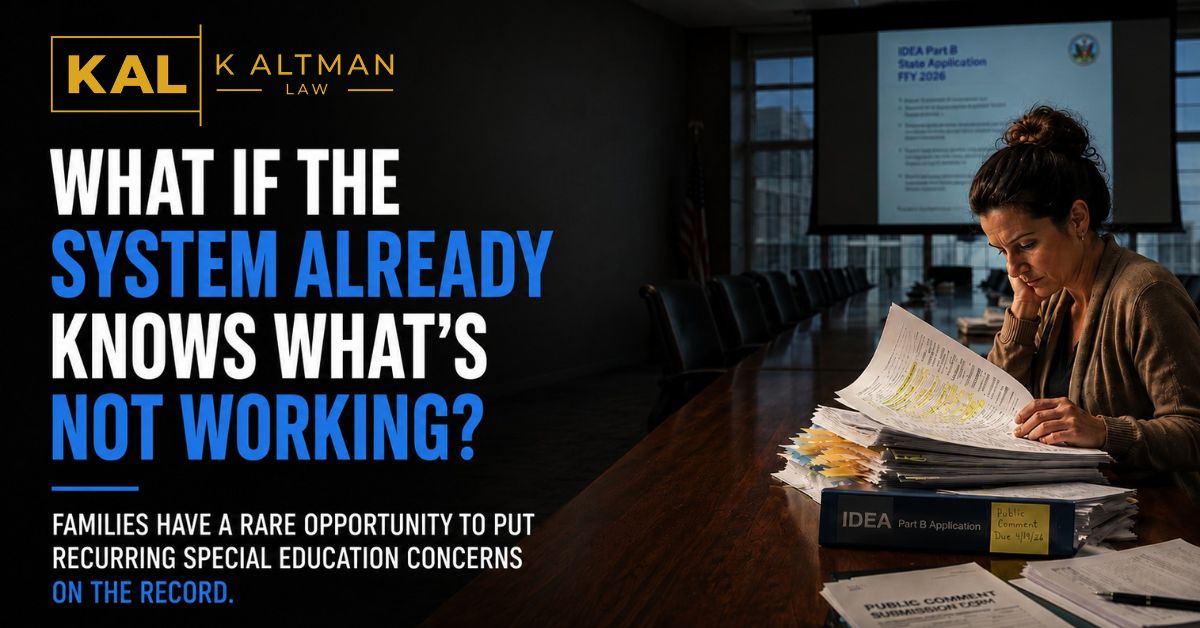
Michigan families have a limited window to challenge recurring special education problems before statewide priorities are finalized.
FARMINGTON HILLS, MI, UNITED STATES, June 16, 2026 /EINPresswire.com/ — Michigan has opened public review and comment on its Federal Fiscal Year 2026 Part B application under the Individuals with Disabilities Education Act, creating an opportunity for families, advocates, and educators to weigh in on statewide special education planning. The Michigan Department of Education announced that the application is available for public review from March 18, 2026 through May 17, 2026, with written comment accepted through April 17, 2026. You can read about it here.
Why this matters:
State IDEA applications may appear administrative, but they often reflect funding assumptions, implementation priorities, and compliance structures that affect students and families on the ground. Michigan noted that the financial section currently reflects the amount provided for FFY 2025 in the absence of estimated figures from the U.S. Department of Education for FFY 2026. Public input is intended to be reviewed and considered in the final version of the application.
For families, this type of comment period can be an important opportunity to raise concerns about evaluations, staffing, service delivery, dispute-resolution patterns, transition planning, transportation, and other recurring access issues. It is also a reminder that state-level implementation choices can shape local district practice long before an individual dispute arises.
K Altman Law perspective:
“Families often focus on their own IEP meeting or dispute, understandably, but state-level special education planning can influence what districts prioritize, how resources are allocated, and how compliance is monitored,” said Keith Altman, Founder and Managing Partner of K Altman Law. “Public comment opportunities are one of the few formal openings for families and advocates to put recurring implementation concerns directly on the record.”
A well-framed public comment does not need to resolve every issue. It should identify patterns, describe practical consequences, and connect concerns to student access and IDEA compliance.
What families should do now:
• Review the application notice and comment deadlines carefully.
• Identify recurring issues such as evaluation delays, staffing shortages, transportation barriers, or implementation gaps.
• Submit concise written comments that focus on systems, timelines, and student impact.
• Keep a copy of your submission and any supporting materials.
• Consider whether local concerns reflect broader statewide patterns that should be raised through public comment.
About K Altman Law:
K Altman Law represents students, families, and professionals in matters involving education law, civil rights, student defense, special education, Title IX, and related administrative and litigation issues nationwide.
Disclaimer:
This press release is for general informational purposes only and is not legal advice. Outcomes vary by facts and jurisdiction. Reading this material does not create an attorney-client relationship.
Keith Altman
K Altman Law
+1 888-984-1341
kalonline@kaltmanlaw.com
Visit us on social media:
LinkedIn
Instagram
Facebook
YouTube
TikTok
X
Legal Disclaimer:
EIN Presswire provides this news content “as is” without warranty of any kind. We do not accept any responsibility or liability
for the accuracy, content, images, videos, licenses, completeness, legality, or reliability of the information contained in this
article. If you have any complaints or copyright issues related to this article, kindly contact the author above.

Media gallery