Preparing critical infrastructure for cyber threats that may have no historical signatures, indicators, or known attack patterns.
NEW YORK, NY, UNITED STATES, June 16, 2026 /EINPresswire.com/ — New cybersecurity framework helps critical infrastructure operators identify previously unseen attack behaviors by correlating network, operational, hardware, industrial protocol, and remote access intelligence.
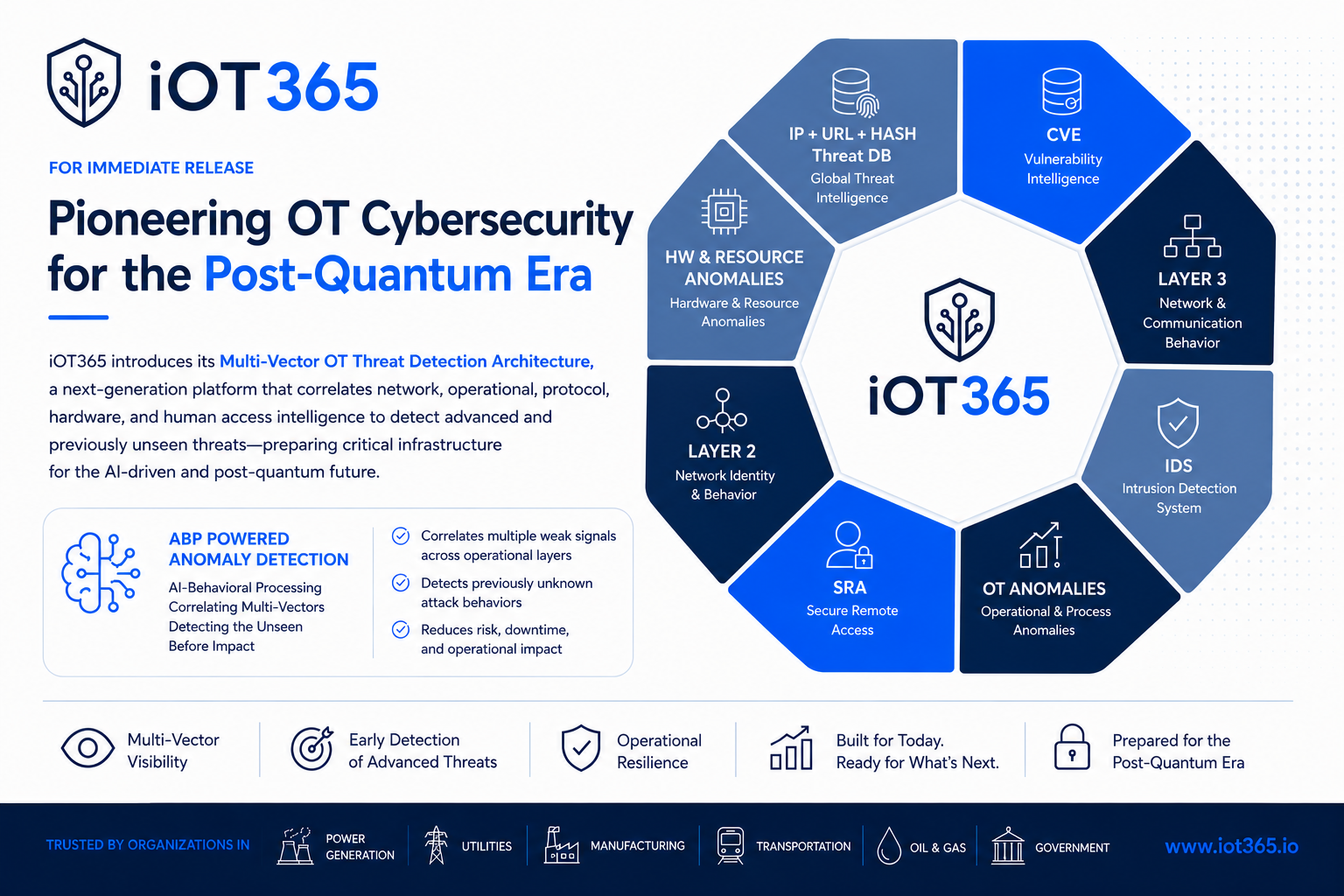
iOT365, an AI-powered OT cybersecurity platform for critical infrastructure, today announced its Multi-Vector OT Threat Detection Architecture, a pioneering cybersecurity capability designed to help industrial organizations detect advanced and previously unknown cyber threats in an era increasingly shaped by artificial intelligence and future post-quantum computing capabilities.
For decades, cybersecurity technologies have relied primarily on signatures, known indicators of compromise, threat intelligence feeds, and previously observed attack techniques. As adversaries gain the ability to automate reconnaissance, generate novel attack paths, and exploit previously unseen combinations of techniques, organizations responsible for critical infrastructure face a growing challenge: how to detect attacks that have no historical precedent.
“The most significant cyber threats of the next decade may not resemble anything we have previously encountered,” said Alexander Tartakovsky, Founder and CEO of iOT365.
“We believe the future of cybersecurity depends on understanding how operational environments normally behave and identifying when that behavior changes, regardless of whether the attack technique itself is known.”
A New Detection Model for Emerging Threats
Rather than relying solely on known attack signatures, the iOT365 Multi-Vector Detection Architecture continuously evaluates operational behavior across multiple intelligence sources, including:
• Layer-2 network behavior and identity changes
• Layer-3 communication patterns
• Industrial protocol activity
• Vulnerability intelligence (CVEs)
• Threat intelligence (IP, URL, and Hash databases)
• Hardware and resource anomalies
• Operational process behavior
• Secure Remote Access activity
• AI-powered anomaly detection
By correlating these signals simultaneously, the platform can identify attack behaviors that may not yet have signatures, threat intelligence indicators, or documented attack procedures.
Detecting Weak Signals Before Operational Impact
Many advanced attacks begin with activities that appear benign when viewed independently, including unauthorized discovery activity, new network identities, unexpected engineering workstation communications, abnormal hardware utilization, unusual remote access behavior, or changes in controller communication patterns.
While any single event may not warrant investigation, correlating indicators across multiple operational layers can reveal the early stages of sophisticated attack campaigns.
During deployments within critical infrastructure environments, iOT365 identified coordinated sequences of anomalous activities involving unauthorized discovery behavior, unexpected engineering communications, abnormal hardware utilization, and new network identities. By correlating these indicators in real time, the platform generated actionable alerts that enabled investigation before operational disruption occurred.
Secure Remote Access as a Security Intelligence Layer
To address one of the most frequently targeted attack surfaces in industrial environments, iOT365 integrates Secure Remote Access directly into its Multi-Vector Detection Architecture.
The capability provides centralized RDP, SSH, VNC, and web-based access management, session monitoring and recording, user activity auditing, and vendor access governance. By treating remote access activity as an additional intelligence source, the platform correlates user behavior with operational, network, and hardware events to provide a more complete view of potential threats.
Preparing Critical Infrastructure for the Post-Quantum Future
The iOT365 platform combines OT IDS, SIEM, SOC Operations, Compliance Intelligence, Secure Remote Access, and AI-powered behavioral analytics within a unified architecture designed to strengthen resilience against both current and emerging threats.
Currently deployed across critical infrastructure environments, including power generation facilities, iOT365 helps operators improve visibility, accelerate detection, and strengthen cyber resilience without interrupting industrial operations.
About iOT365
iOT365 is an AI-powered OT cybersecurity platform designed for critical infrastructure, power generation, utilities, manufacturing, transportation, ports, airports, and other continuously operating environments. The platform unifies OT Intrusion Detection, SIEM, SOC Operations, Compliance Intelligence, Secure Remote Access, and AI-powered operational visibility through a passive deployment model that enables rapid implementation without operational interruption.
Media Contact
Slava Anisimov
COO, iOT365
Email: contact@iot365.io
Website: https://www.iot365.io
Vyatcheslav Anisimov
iOT365 Inc.
+1 332-280-4993
email us here
Visit us on social media:
LinkedIn
YouTube
Why Fragmented OT Cybersecurity Is Failing | iOT365 Architecture
Legal Disclaimer:
EIN Presswire provides this news content “as is” without warranty of any kind. We do not accept any responsibility or liability
for the accuracy, content, images, videos, licenses, completeness, legality, or reliability of the information contained in this
article. If you have any complaints or copyright issues related to this article, kindly contact the author above.

Media gallery