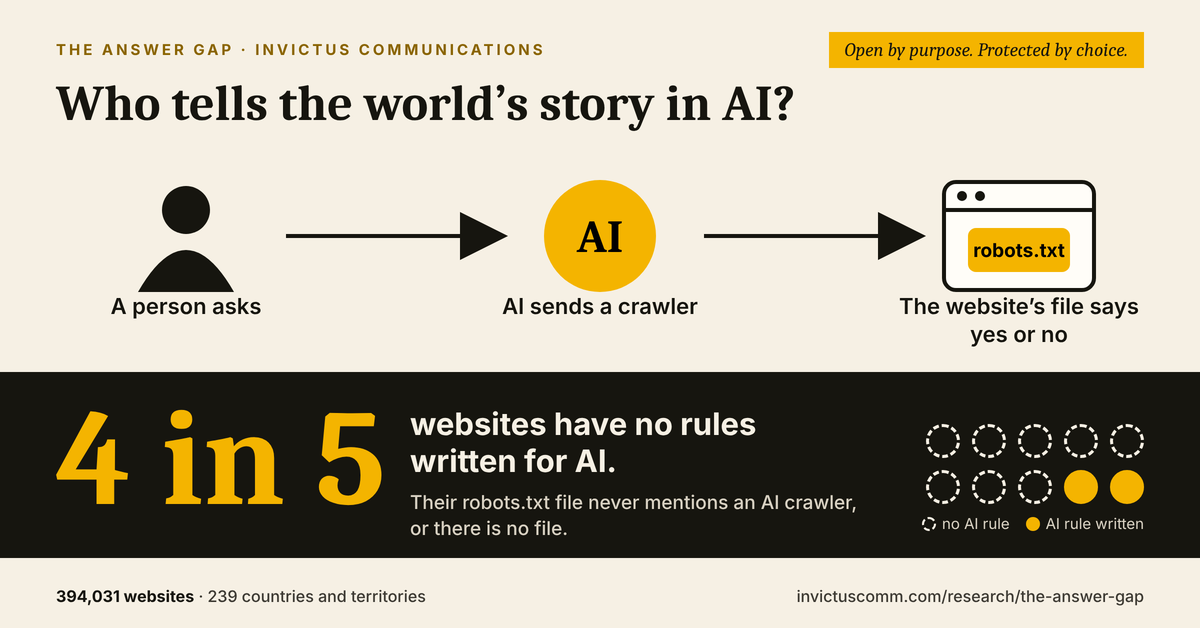

Open by purpose. Protected by choice. Global research on 394,031 websites examines digital inclusion, access to information and representation in AI answers.
NEW YORK, NY, UNITED STATES, November 24, 2026 /EINPresswire.com/ — Invictus Communications today publishes The Answer Gap, global research on digital inclusion and how people and organizations are represented in artificial intelligence (AI) answers. Covering 394,031 websites in 239 countries and territories, it finds that websites grant different permissions to different AI companies. It also finds that four in five websites with a clear result have no rule written for AI.
Digital inclusion in the age of AI
Digital inclusion encompasses connectivity, access to technology, accessibility and digital skills. The Answer Gap examines further dimensions: access to information, digital identity, representation and informed choice.
Digital inclusion concerns both obtaining information and making it available to others. They apply to people with limited access to technology and to some of the world’s largest institutions. A company may have a sophisticated website and a large communications budget, however, its own information may still be missing from the sources an AI assistant uses to describe it.
An organization’s digital inclusion can also affect the people and communities it serves. Customers, employees, investors, students and citizens may use AI answers in their decisions.
The research considers the interests of those seeking information, those providing it, the AI companies processing it and the people and institutions being represented.
Research findings
Every website can publish a public file, called robots.txt, that states which pages crawlers may access. Crawlers, or bots, collect pages for AI assistants such as ChatGPT, Gemini, Claude, Grok and Perplexity.
Of the 240,870 websites with a clear result, 79.9 percent have no robots.txt file, or one that never mentions any of the AI crawlers measured. The figure is 87.2 percent for government websites and 87.9 percent for university websites.
Internationally, it is 75.7 percent in the United States and 79.1 percent in Canada. It is 77.5 percent in the United Kingdom and 84.1 percent in Germany. In Australia it is 78.0 percent and in Japan 84.5 percent. India stands at 81.6 percent and Brazil at 80.2 percent.
Having no rule for AI does not mean being closed to AI: 91.9 percent of them allow all six crawlers that answer questions for OpenAI, Anthropic and Perplexity.
Across 26,258 confirmed news outlets, 98.0 percent allow Google’s search crawler. The share is 88.7 percent for OpenAI, which makes ChatGPT, and 86.3 percent for Perplexity. OpenAI uses two crawlers to answer questions. Among the most-visited news websites in the United States, 26 percent (774 of 2,980) tell both to stay out. In Canada it is 23.7 percent (61 of 257).
ChatGPT, Gemini and Grok were asked to open the websites of 27 banks, stock exchanges and tourism bodies. At least one assistant reported being unable to open the website of seven organizations. Eight of the nine unsuccessful tests gave the same result when repeated.
From visibility to representation
The findings contribute to search engine optimization (SEO), answer engine optimization (AEO), generative engine optimization (GEO) and large language model optimization (LLMO). The research gives these fields data and methods for checking crawler permissions, the sources assistants cite and the accuracy of an organization’s representation.
During disruptions to communications, aviation and banking services, communications teams can check whether AI assistants find and cite their official statements.
The free AI-Readable Sources Index shows which AI crawlers a website allows and compares the results by sector and country. The Answer Standard is a method for checking which pages assistants open, what they cite and how accurately they answer. Together, they help leadership, communications teams and industry bodies base decisions about access, representation and protection on evidence.
Access, protection and informed choice
Digital inclusion does not require unrestricted access to information. It must also recognize the rights of information providers, including privacy, security, intellectual property, attribution and choice over how their information is used.
Under the report’s guiding principle, each organization decides what to open to AI, what to protect and whether its content may train AI. Those decisions should be informed by evidence about accessibility, representation and the organization’s responsibilities to the people it serves.
The Index is at https://invictuscomm.com/index/
The report summary is at https://invictuscomm.com/research/the-answer-gap/
Journalists, researchers and regulators can request the full report free of charge.
About Invictus Communications
Invictus Communications is a communications and research consultancy.
Lindsay McDonald
Invictus Communications
lindsay@invictuscomm.com
Legal Disclaimer:
EIN Presswire provides this news content “as is” without warranty of any kind. We do not accept any responsibility or liability
for the accuracy, content, images, videos, licenses, completeness, legality, or reliability of the information contained in this
article. If you have any complaints or copyright issues related to this article, kindly contact the author above.

Media gallery